
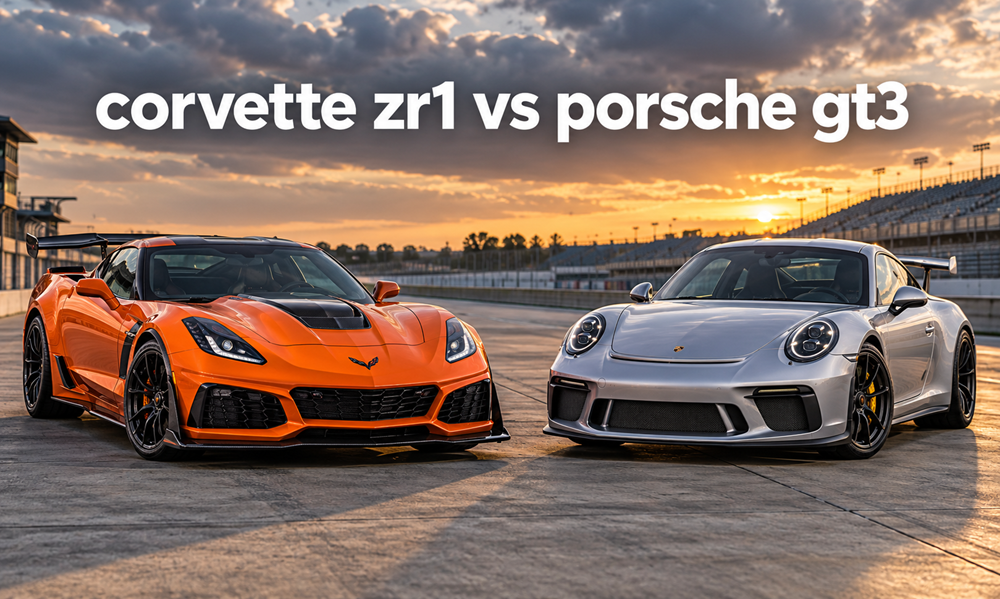

The modern corvette zr1 vs porsche gt3 debate brings together two radically different interpretations of a track-capable road car. The Chevrolet Corvette ZR1 attacks the problem with a mid-engine layout, twin turbochargers, huge power, active chassis technology, and extreme aerodynamic potential. The Porsche 911 GT3 takes another route, using a naturally aspirated flat-six, lower mass, rear-engine balance, detailed chassis tuning, and the option of a traditional manual transmission.
For U.S. enthusiasts, the comparison is especially interesting because the cars now occupy overlapping price territory even though their performance philosophies are far apart. The ZR1 is designed to deliver hypercar-level acceleration and top speed. The GT3 is built around response, precision, driver feedback, and repeatable circuit performance. Looking at the numbers only tells part of the story, so a useful comparison also has to consider how each car creates speed and what ownership may feel like away from a racetrack.
Current manufacturer listings may show different model years at the same time because Chevrolet and Porsche update their U.S. lineups on different schedules. The core specifications below reflect the currently published U.S.-market ZR1 and GT3 information available from the manufacturers in 2026.
What Are the Biggest Differences Between the Corvette ZR1 and Porsche GT3?
The biggest difference is engine philosophy. The Corvette ZR1 uses Chevrolet’s LT7, a 5.5-liter twin-turbocharged DOHC V8 with a flat-plane crankshaft. It produces 1,064 horsepower and 828 lb-ft of torque. The current Porsche 911 GT3 uses a 4.0-liter naturally aspirated flat-six producing 502 horsepower and 331 lb-ft of torque, with a 9,000-rpm maximum engine speed.
That enormous power gap does not mean the cars pursue the same objective at different levels. The Porsche is much lighter and is engineered around response, chassis balance, braking confidence, and the ability to communicate grip to the driver. The Corvette uses its power, wider performance envelope, mid-engine traction, and available high-downforce hardware to create a much more explosive experience.
How Do the Corvette ZR1 and Porsche GT3 Compare on Paper?
| Specification | Chevrolet Corvette ZR1 | Porsche 911 GT3 |
| Engine | 5.5L twin-turbo flat-plane-crank V8 | 4.0L naturally aspirated flat-six |
| Horsepower | 1,064 hp | 502 hp |
| Torque | 828 lb-ft | 331 lb-ft |
| Drivetrain | Rear-wheel drive | Rear-wheel drive |
| Transmission | 8-speed dual-clutch | 7-speed PDK or 6-speed manual |
| 0-60 mph | As quick as 2.3 sec with ZTK | 3.2 sec PDK; 3.7 sec manual |
| Top speed | 233 mph | 193 mph PDK; about 194-195 mph manual |
| Published U.S. starting price | $185,000 for 2026 ZR1 | $238,150 on current U.S. GT3 listing |
| Weight reference | 3,670 lb dry weight for 2026 coupe | About 3,240 lb curb weight, depending on configuration |
| Core personality | Extreme power and aero performance | Precision, low weight, and driver engagement |
Pricing and model-year labels can change. Manufacturer suggested retail prices exclude taxes, registration, dealer charges, options, and other fees unless stated otherwise.
Which Car Is Faster in a Straight Line?
The Corvette ZR1 has the clear numerical advantage in straight-line performance. Chevrolet lists an available 0-to-60-mph time of 2.3 seconds with the ZTK Performance Package and a quarter-mile time of 9.6 seconds at 150 mph. Its published track top speed is 233 mph. Those figures come from a car with more than twice the horsepower of the GT3.
The GT3 is still exceptionally quick in real-world terms. Porsche lists 0 to 60 mph in 3.2 seconds with the PDK transmission, while the manual version takes roughly 3.7 seconds. The GT3 is not designed to win a horsepower contest. Its acceleration is part of a larger package built around high-rpm response, gearing, corner speed, braking, and driver involvement.
Chevrolet’s current official Corvette ZR1 page details the LT7 V8, 1,064-hp output, 233-mph top speed, and available ZTK performance figures.
Why Does the Porsche GT3 Use So Much Less Power?
Porsche has traditionally treated the GT3 as a road-going extension of its motorsport engineering rather than as the most powerful 911. The current car keeps a naturally aspirated 4.0-liter engine because throttle response, engine character, high-rpm operation, and predictable power delivery are central to the model’s identity.
The flat-six produces peak power high in the rev range and can spin to 9,000 rpm. That changes the way the driver interacts with the car. Instead of relying on a huge wall of turbocharged torque, the GT3 encourages the driver to use the gearbox, keep the engine in its operating range, and work with the chassis to build speed.
This also explains why Porsche continues to offer a six-speed manual. Buyers who prioritize lap-time efficiency can choose the PDK dual-clutch transmission, while those who want greater mechanical involvement can choose the manual without giving up the core GT3 chassis.
What Makes the Corvette ZR1 So Extreme?
The current ZR1 is a very different car from older front-engine Corvette ZR1 generations. The C8 platform places the engine behind the driver, improving rear traction and allowing Chevrolet to package major cooling and aerodynamic systems around the mid-engine body.
The LT7 engine shares its basic 5.5-liter architecture and flat-plane-crank concept with the naturally aspirated LT6 used in the Corvette Z06, but adds twin turbochargers and extensive changes for far greater output. The result is 1,064 horsepower without hybrid assistance.
With the available carbon-fiber aerodynamic package, Chevrolet says the ZR1 can generate more than 1,200 pounds of downforce at top speed. Carbon-ceramic brakes are standard, and Magnetic Selective Ride Control 4.0 continuously adjusts damping to help the car work on both road and track surfaces.
Which Car Offers the More Traditional Driver Experience?
Drivers who define a traditional sports-car experience by a high-revving naturally aspirated engine, compact dimensions, light weight, steering detail, and a manual gearbox will find more of those ingredients in the GT3. The engine sits behind the rear axle, maintaining the unusual layout that has defined the 911 for generations.
The ZR1 is more technology-intensive in the way it delivers performance. Its eight-speed dual-clutch transmission is the only gearbox, and the car uses turbocharging, active damping, advanced traction systems, and substantial aerodynamic development to manage its enormous performance envelope.
Neither approach is inherently more authentic. They simply reward different kinds of engagement. The Porsche makes speed through accuracy and momentum. The Chevrolet can create huge speed almost anywhere the driver can safely deploy its power.
How Do Their Track Personalities Differ?
On a circuit, the ZR1 can combine massive acceleration with serious braking and aero capability. Long straights and high-speed sections allow the Corvette to use its power advantage, while the ZTK package adds track-focused tires, suspension calibration, and high-downforce aerodynamic hardware.
The GT3 takes a more surgical approach. Porsche revised its damping, front suspension behavior, and gearing for the latest generation, drawing lessons from the GT3 RS. The emphasis is on keeping the platform stable over bumps and curbs while maintaining clear feedback at the limit.
Porsche demonstrated that focus when a manual-transmission GT3 with the Weissach Package completed the Nürburgring Nordschleife in 6:56.294. Porsche’s official Nürburgring release notes that the run used road-legal Michelin Pilot Sport Cup 2 R tires. Manufacturer lap times from different days and vehicles should not be treated as a direct head-to-head test, but the result illustrates how much performance the GT3 extracts from a comparatively modest power figure.
Which Car Has the Better Transmission Choice?
The Corvette ZR1 uses an eight-speed dual-clutch automatic. For a car producing 1,064 horsepower, the fast-shifting DCT helps keep acceleration consistent and allows the driver to focus on braking, steering, and throttle application.
The GT3 gives buyers a choice between a seven-speed PDK and a six-speed manual. PDK is the quicker choice for acceleration and track consistency. The manual adds clutch and shift inputs that many enthusiasts still value, and Porsche has continued developing the manual GT3 rather than treating it as a nostalgia-only option.
For buyers, the decision is less about which transmission technology is objectively superior and more about the experience they want. The Corvette prioritizes repeatable speed. The Porsche allows either repeatable speed or greater mechanical interaction.
How Do Aerodynamics and Brakes Compare?
Both cars use aerodynamics as a core performance tool, but the ZR1 can become dramatically more aggressive when equipped with its high-downforce package. The large rear wing, underbody elements, dive planes, and front aerodynamic work are designed to keep the car stable at speeds that would have been hypercar territory only a few years ago.
The GT3 uses a swan-neck rear wing that mounts from above, helping clean airflow across the underside of the wing. Porsche also uses a functional front fascia, underbody management, and carefully tuned chassis geometry rather than relying only on dramatic wing area.
Braking philosophy is similarly serious. The ZR1 includes carbon-ceramic brakes as standard equipment. The GT3 can be configured with Porsche Ceramic Composite Brakes, while high-performance steel brakes are standard. Track drivers should consider replacement costs, heat management, pad selection, and intended circuit use when deciding between brake setups.
What Is Each Car Like on Public Roads?
Despite the performance numbers, both cars are street legal and include modern comfort and connectivity features. The Corvette has a wider, more exotic mid-engine footprint and can feel like a supercar even at ordinary speeds. Its low seating position, broad rear bodywork, and visibility considerations may require more adjustment in tight parking areas.
The 911 GT3 retains the basic packaging advantages of the 911 shape. It is still low and stiff compared with a normal sports car, but the narrow cabin footprint and familiar outward visibility can make it easier to place on typical roads. The available Touring Package also removes the fixed rear wing for drivers who want more discreet styling.
Ride comfort depends heavily on roads, tires, seat choices, and configuration. Either car can be used beyond track days, but owners should expect more road noise, tire expense, low-clearance concerns, and attention from other drivers than they would receive in a conventional performance coupe.
How Do Pricing and Value Compare in the United States?
For the 2026 model year, Chevrolet listed the Corvette ZR1 at $185,000 before options and applicable fees. Porsche’s current U.S. model comparison tool lists the 911 GT3 from $238,150. The Porsche therefore carries a higher starting price even though it produces much less horsepower.
Horsepower per dollar is not the only way buyers evaluate cars at this level. The GT3 price reflects the 911 platform, low-volume GT engineering, motorsport-derived components, chassis tuning, and strong demand for the model. The ZR1 offers extraordinary output and speed for its price, but desirable carbon-fiber, aero, interior, wheel, and performance options can raise the final transaction price substantially.
Porsche’s current U.S. 911 model comparison page lists the GT3’s current price, 502-hp output, acceleration, top speed, and available transmission choices.
Which One Is More Practical to Own?
Practicality at this level is relative. Both cars use expensive tires, specialized brakes, premium fuel, and components designed for high performance. Insurance costs can also vary significantly by driver, state, storage location, annual mileage, and coverage level.
The Corvette benefits from a large U.S. Chevrolet dealer network, although ZR1-specific expertise and parts are more specialized than on a normal Chevrolet. Porsche has a smaller dealer network but a long-established service ecosystem for GT models and track-focused 911 owners.
Buyers planning regular circuit use should budget separately for consumables such as tires, brake pads, fluids, alignment work, and track insurance. These expenses can matter more over time than the difference in routine scheduled maintenance.
Which Type of Driver Does Each Car Suit?
| Priority | ZR1 may appeal more if… | GT3 may appeal more if… |
| Straight-line speed | You want extreme acceleration and very high top speed | Acceleration matters, but is not the main reason you are buying |
| Engine character | You want twin-turbo V8 force and huge torque | You want a naturally aspirated engine that revs to 9,000 rpm |
| Transmission | A fast dual-clutch gearbox is preferred | You want a choice between PDK and a six-speed manual |
| Track style | You value power, aero load, braking, and high-speed capability | You value low mass, precision, feedback, and momentum |
| Visual presence | You want an exotic mid-engine shape | You prefer the more familiar 911 silhouette |
| Budget approach | You want maximum factory performance near the $200K level | You accept a higher base price for the GT3 formula and 911 platform |
Frequently Asked Questions
Is the Corvette ZR1 faster than the Porsche GT3 in a straight line?
Based on current manufacturer figures, yes. Chevrolet lists the ZR1 at as quick as 2.3 seconds from 0 to 60 mph, while Porsche lists the GT3 at 3.2 seconds with PDK. The ZR1 also has a much higher published top speed.
How much horsepower does the Corvette ZR1 have?
The current Corvette ZR1 produces 1,064 horsepower and 828 lb-ft of torque from a twin-turbocharged 5.5-liter LT7 V8.
How much horsepower does the Porsche 911 GT3 have?
The current 911 GT3 produces 502 horsepower from a naturally aspirated 4.0-liter flat-six engine.
Can you get a manual transmission in the ZR1?
No. The current ZR1 uses an eight-speed dual-clutch transmission. The 911 GT3 offers either a seven-speed PDK or a six-speed manual.
Which car has the higher top speed?
Chevrolet lists the ZR1 at 233 mph on the track. Porsche lists the current GT3 at roughly 193 to 195 mph depending on transmission and specification.
Is the Porsche GT3 lighter than the ZR1?
Yes. Current GT3 configurations are around the low 3,200-pound range in curb weight, while Chevrolet lists the 2026 ZR1 coupe at 3,670 pounds dry. The measurement standards differ, so those figures should not be treated as a direct curb-weight comparison.
Is the GT3 better for daily driving?
Daily usability depends on the driver, roads, seats, tires, and options. The GT3 has compact dimensions and familiar 911 visibility, while the ZR1 offers modern Corvette comfort but has a wider, more exotic mid-engine footprint.
Why does the GT3 cost more despite having less horsepower?
The GT3 price reflects its 911 platform, specialized GT chassis, low-volume engineering, motorsport-derived hardware, and market positioning. Its appeal is based more on response, precision, and driver involvement than maximum horsepower.
Final Thoughts
The Corvette ZR1 and Porsche 911 GT3 show how differently two manufacturers can approach the same broad goal of building an extraordinary road-legal track car. The ZR1 uses massive turbocharged power, a mid-engine layout, advanced aerodynamics, and dual-clutch speed to push Corvette performance into territory once reserved for far more expensive exotics.
The GT3 remains focused on a different kind of intensity. Its 502-hp naturally aspirated engine, 9,000-rpm character, lighter chassis, rear-engine balance, and available manual transmission emphasize control and communication rather than headline output.
For U.S. buyers, the useful question is not simply which car has the bigger number. It is whether the desired experience centers on explosive acceleration and extreme performance capacity, or on precision, engine response, and driver involvement. Both cars can deliver serious track capability, but they reach that destination through very different engineering philosophies.
Editorial note: Specifications reflect current U.S.-market manufacturer information available in 2026. Model years, prices, options, performance claims, and availability can change. Verify current specifications with Chevrolet and Porsche before purchase.

1 Comment
Comments are closed.


[…] one of America’s most iconic sports cars. This comprehensive guide delves into the world of Corvette wheels, focusing on the popular C6, C7, and C8 models, ensuring a perfect synergy between […]