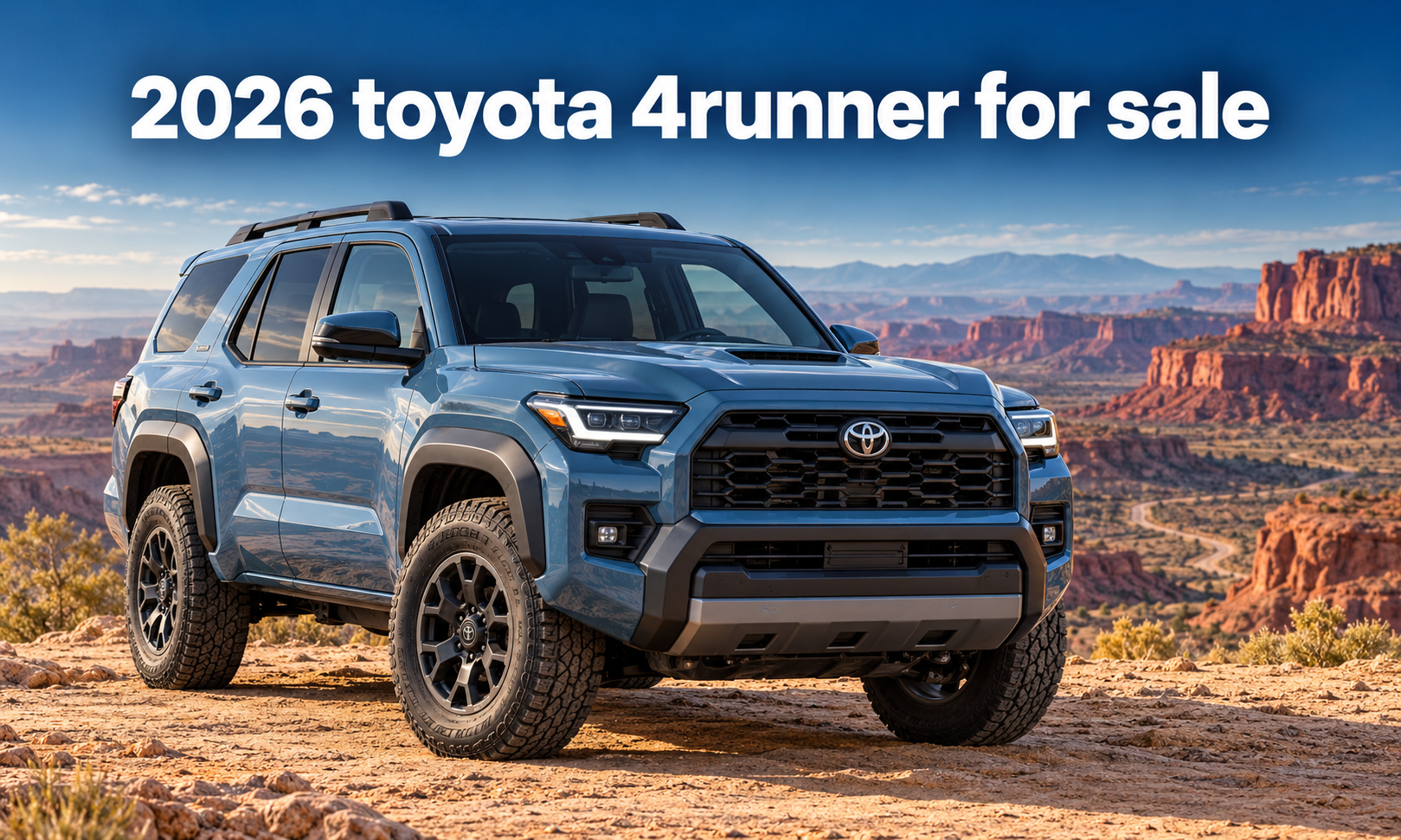
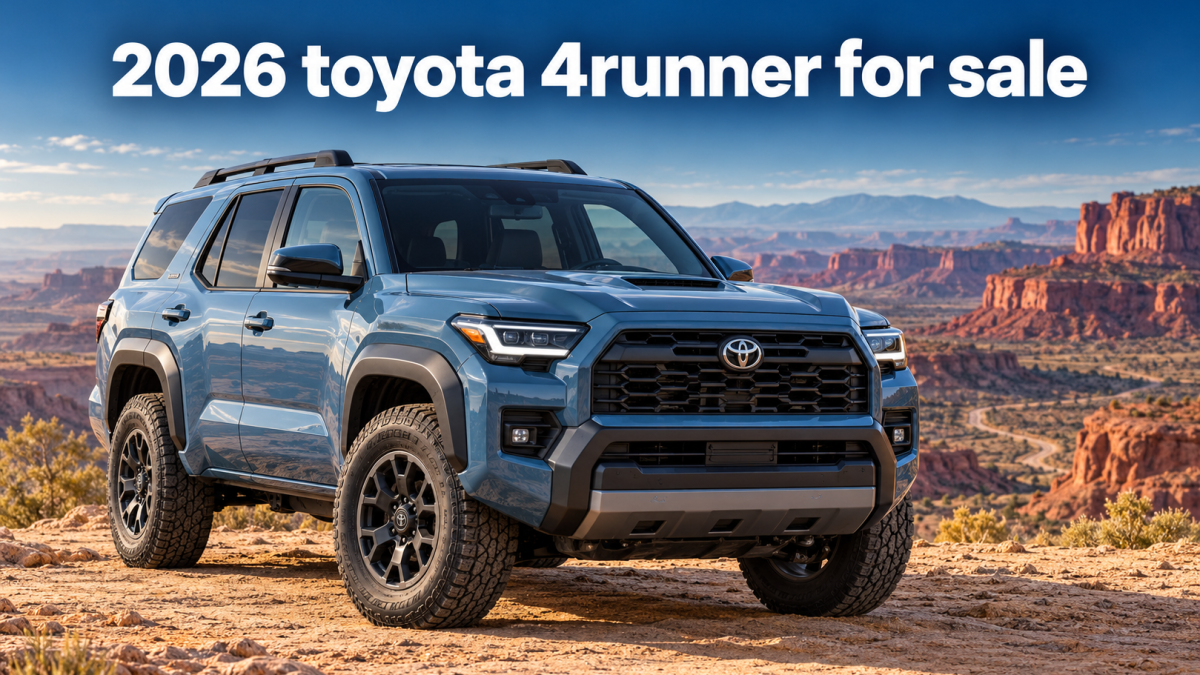

If you are searching for a 2026 toyota 4runner for sale, you are shopping one of the newest versions of Toyota’s long-running body-on-frame SUV. The sixth-generation 4Runner arrived with a turbocharged four-cylinder engine, an available i-FORCE MAX hybrid, modern infotainment, Toyota Safety Sense 3.0, and a much broader mix of road-focused and trail-focused trims than the old model.
For U.S. buyers in 2026, the challenge is not simply finding a 4Runner. It is deciding which configuration is worth the money. Toyota lists the 2026 4Runner from $42,270 before destination and other charges, while high-end off-road versions move well into the $60,000 range. Dealer inventory can also vary sharply by region, especially for TRD Pro, Trailhunter, hybrid, and heavily optioned models.
Is the 2026 Toyota 4Runner Available for Sale Now?
Yes. The 2026 4Runner reached U.S. dealerships after Toyota announced fall 2025 availability, and new examples are currently shown through Toyota’s shopping and inventory tools. Availability is not equal across every trim, however. Mainstream SR5, TRD Sport, Limited, and TRD Off-Road models may be easier to locate than Trailhunter, TRD Pro, or specific i-FORCE MAX combinations.
When comparing listings, pay attention to whether the advertised number is the manufacturer’s suggested retail price, the dealer’s asking price, or an estimated monthly payment. A vehicle can look attractively priced in a search result while carrying dealer-installed accessories, protection packages, market adjustments, or financing conditions that raise the final amount.
What Is the Starting Price of a 2026 4Runner?
Toyota currently lists a starting MSRP of $42,270 for the 2026 4Runner SR5. That figure is before destination, taxes, registration, documentation fees, accessories, and any dealer-added products.
Car and Driver’s pricing page may show a higher entry figure because published totals can include destination charges. That is why buyers should compare the full out-the-door price rather than assuming two websites are quoting the same type of number.
| 2026 4Runner Trim | Current Starting Price* | Best Fit |
| SR5 | $42,270 | Value-focused daily driving, available third row |
| TRD Sport | $48,750 | Street-oriented styling and sport-tuned suspension |
| TRD Off-Road | $50,690 | Trail use without jumping to top-tier pricing |
| TRD Off-Road i-FORCE MAX | $53,490 | More torque with off-road hardware |
| Limited | About $56,900 | Comfort and convenience focused buyers |
| Limited i-FORCE MAX | $61,700 | Premium equipment with hybrid torque |
| Trailhunter | High-$60,000 range | Overlanding and factory adventure equipment |
| TRD Pro | High-$60,000 range | Maximum factory off-road performance |
*Pricing can vary by region and configuration. Always confirm current MSRP, destination charge, options, and dealer pricing before purchase.
Which 2026 4Runner Powertrain Should You Buy?
Toyota offers two powertrains. The standard i-FORCE setup uses a turbocharged 2.4-liter four-cylinder engine rated at 278 horsepower and 317 lb-ft of torque. It is paired with an eight-speed automatic transmission and is available with different drivetrain configurations depending on trim.
The i-FORCE MAX hybrid combines the turbocharged engine with an electric motor and battery system for up to 326 horsepower and 465 lb-ft of torque. The biggest real-world advantage is the extra low-end torque, which can make the heavier SUV feel more responsive during passing, climbing, towing, and low-speed trail driving.
The hybrid is not simply a fuel-economy option. Toyota uses it heavily in the most capable and premium versions of the 4Runner, so buyers choosing Trailhunter, TRD Pro, or certain upper trims may be selecting the hybrid because of equipment and performance as much as fuel savings.
How Do the Gas and Hybrid 4Runners Compare?
| Powertrain | Output | Fuel Economy | Why Choose It |
| i-FORCE 2.4L turbo | 278 hp / 317 lb-ft | Up to about 20/26 mpg city/highway | Lower purchase price and simpler lineup entry |
| i-FORCE MAX hybrid | 326 hp / 465 lb-ft | Up to about 23 mpg combined | Stronger torque and access to several premium/off-road trims |
Which 4Runner Trim Makes the Most Sense for Everyday Driving?
For buyers who mainly commute, take family trips, and occasionally use dirt roads, the SR5 can be a sensible place to start. It offers the new-generation platform and technology without forcing buyers into expensive off-road equipment they may rarely use.
TRD Sport models are more appearance and pavement focused, while Limited models add a more premium feel. If comfort, highway travel, technology, and cabin features matter more than rock crawling, these versions may make more sense than Trailhunter or TRD Pro.
Which 4Runner Is Best for Off-Road Use?
The TRD Off-Road family is the practical middle ground for buyers who genuinely use trails but do not need every factory overlanding upgrade. Toyota equips these models with hardware such as all-terrain tires, off-road-focused suspension components, terrain-management features, and available stabilizer-disconnect technology depending on configuration.
Trailhunter is aimed more directly at overlanding, while TRD Pro sits at the aggressive end of the factory lineup. These trims make sense when their specialized shocks, tires, protection, and trail equipment will actually be used. Paying for them only for appearance can make the 4Runner unnecessarily expensive.
How Much Ground Clearance Does the 2026 4Runner Have?
Toyota lists ground clearance of up to 10.1 inches depending on configuration. That is one reason the 4Runner remains attractive to drivers who regularly deal with rough roads, trail obstacles, snow, or remote access routes.
Ground clearance is only part of off-road capability. Tire choice, approach and departure angles, suspension articulation, four-wheel-drive hardware, locking differentials, driver skill, and underbody protection also matter.
Can the 2026 4Runner Seat Seven People?
Yes, but only certain configurations offer third-row seating. Toyota lists seating capacity of up to seven, while many off-road-oriented trims remain two-row vehicles.
If you need the third row regularly, confirm the exact vehicle on the window sticker before buying. The 4Runner’s available third row is more useful for children or occasional short trips than for adults who need generous space on long drives.
What Technology Comes With the New 4Runner?
The redesign brought the 4Runner much closer to Toyota’s newest trucks and SUVs. Entry models use an 8-inch Toyota Audio Multimedia touchscreen, while higher trims can be equipped with a 14-inch display. Wireless Apple CarPlay and Android Auto are available across the lineup, and upper trims add features such as upgraded cameras, premium audio, larger digital displays, heated and ventilated seating, and additional trail-view technology.
Shoppers can compare the current trim equipment directly on Toyota’s official 2026 4Runner page before visiting a dealer.
What Safety Features Are Standard?
Toyota Safety Sense 3.0 is standard across the 2026 4Runner lineup. The suite includes features such as pre-collision assistance with pedestrian detection, lane-departure alert with steering assist, full-speed-range adaptive cruise control, lane-tracing assist, road-sign assist, automatic high beams, and proactive driving assist.
Driver-assistance systems can reduce workload, but they do not replace attentive driving. Feature behavior can also vary with road markings, weather, speed, and sensor visibility.
Where Can You Find a 2026 Toyota 4Runner for Sale?
Start with Toyota’s own inventory tools, then compare listings from multiple local dealers. Searching a wider radius can be worthwhile if you want a rare color, Trailhunter, TRD Pro, specific hybrid configuration, or a vehicle without dealer-installed accessories.
Toyota’s main shopping site includes a Search Inventory tool that can be used to check vehicles currently listed by participating dealers.
Do not assume the nearest dealer automatically has the best deal. Ask several dealers for a written out-the-door quote that includes the vehicle price, destination, taxes, title and registration, documentation fees, accessories, protection products, and any market adjustment.
Should You Pay a Dealer Markup on a 2026 4Runner?
That depends on local supply, the exact trim, and how urgently you need the vehicle, but a markup is not part of Toyota’s MSRP. Buyers should separate factory pricing from dealer-added charges.
Scarce trims can create pressure to pay more, especially if the vehicle has a popular color or unusual option combination. Before agreeing, check inventory in nearby cities, ask whether another unit is incoming, compare an order or reservation if available, and calculate how much the markup changes your total loan cost.
What Should You Check Before Signing the Purchase Paperwork?
Ask for the Monroney window sticker and verify that the trim, drivetrain, engine, packages, accessories, wheel and tire setup, and color match the listing. Then compare the selling price with the sticker price and identify every additional charge.
Inspect the vehicle itself before delivery. Check the paint, wheels, tires, glass, underbody, interior trim, electronics, cameras, rear window operation, liftgate, spare tire or repair equipment, and all keys. If the 4Runner has been used for demonstrations or test drives, confirm the mileage and condition before accepting it as new.
Should You Check for Recalls Before Buying?
Yes. Even a brand-new model can become subject to a recall after production begins. A recall does not automatically mean the vehicle is unreliable, but it does mean a specific safety or compliance issue may need correction.
Use the NHTSA VIN recall lookup to check the exact vehicle before or immediately after purchase. VIN-based results are more useful than relying on a general model-year list.
How Does the 2026 4Runner Compare With the Previous Generation?
The biggest change is the powertrain. The previous-generation 4Runner relied on a naturally aspirated V6 and five-speed automatic for many years. The current model replaces that combination with turbocharged four-cylinder power and an eight-speed automatic, plus an available hybrid.
The newer model also adds significantly more technology, more refined road manners, modern safety systems, and a wider range of trim personalities. At the same time, it keeps the body-on-frame layout and the roll-down rear glass that many longtime 4Runner owners value.
Is the 2026 Toyota 4Runner Worth Buying?
It makes the most sense for buyers who actually want the attributes that separate a 4Runner from a typical crossover: body-on-frame construction, genuine four-wheel-drive capability, strong trail hardware, substantial ground clearance, and a truck-like driving position.
If your priority is maximum fuel economy, soft ride quality, third-row space, or the lowest possible purchase price, a conventional crossover may be a better fit. But if you want a vehicle that can handle commuting during the week and difficult roads on weekends, the 4Runner remains unusually versatile.
Frequently Asked Questions About the 2026 Toyota 4Runner
How much does a 2026 Toyota 4Runner cost?
Toyota currently lists the 2026 4Runner from $42,270 before destination, taxes, fees, options, and dealer-added products. Higher trims can move into the high-$60,000 range.
Is the 2026 Toyota 4Runner available now?
Yes. The 2026 model reached U.S. dealerships after Toyota announced fall 2025 availability. Exact inventory depends on your region and desired trim.
Does the 2026 4Runner have a V6?
No. The current 4Runner uses a turbocharged 2.4-liter four-cylinder, either as the 278-hp i-FORCE engine or as part of the 326-hp i-FORCE MAX hybrid system.
Does the 2026 4Runner come as a hybrid?
Yes. The i-FORCE MAX hybrid produces up to 326 horsepower and 465 lb-ft of torque and is used on several premium and off-road configurations.
Can the 2026 4Runner seat seven?
Some configurations offer an available third row for up to seven passengers. Many off-road-focused trims are two-row models.
Which 4Runner trim is best for off-roading?
TRD Off-Road models provide a strong balance of capability and price. Trailhunter and TRD Pro add more specialized factory off-road equipment for buyers who need it.
Where should I shop for a 2026 4Runner?
Start with Toyota’s official inventory tools and compare several nearby dealerships. Ask each dealer for a complete out-the-door quote instead of comparing only monthly payments.
Should I buy the gas or hybrid 4Runner?
Choose based on the trim and capability you need. The gas engine lowers the entry price, while the hybrid delivers significantly more torque and is bundled with several of the most capable versions.
Final Thoughts
Finding a 2026 Toyota 4Runner for sale is relatively straightforward, but finding the right one at the right price requires more work. The lineup now spans basic SR5 models, street-focused TRD Sport versions, premium Limited and Platinum models, and serious off-road choices such as TRD Off-Road, Trailhunter, and TRD Pro.
Start by deciding whether you need the standard i-FORCE engine or the stronger i-FORCE MAX hybrid, then narrow the search by drivetrain, seating, trail equipment, and budget. Once you find a candidate, compare the window sticker with the dealer’s full out-the-door quote, verify any accessories or markups, inspect the vehicle, and check the VIN for open recalls.
That process makes it easier to separate a genuinely good 4Runner purchase from an expensive listing that only looks attractive at first glance.
This article is written for the U.S. market using 2026 model-year information available in October 2026. Prices, inventory, incentives, options, destination charges, and dealer pricing can change. Confirm current details before purchasing.
2026 Toyota 4Runner for Sale: Prices, Trims, Features, and Buying Advice for U.S. Shoppers